The Metacognitive Framework
Introduction
You, as an individual, never possess a static identity. You grow and change over time as different priorities take precedence in different, also changing, circumstances. To reflect this in the Metacognitive Framework, envision yourself as a snake, weaving through different ways of thinking as you encounter new experiences, insights, and struggles. Your “length” as a snake, the number of ranks you actively occupy at any given time, depends entirely on what you’ve lived through, what you’ve learned, and how you’ve chosen to respond.
This also means the framework itself isn’t static, even within a single person. Someone can respond to the same kind of situation in different ways depending on the day, the stakes, their past, how they feel, or who’s involved, sometimes moving toward a more developed response and sometimes falling back onto an older one, often without noticing as it happens. Personal growth and growth throughout the Metacognitive Framework don’t erase the earlier ways of thinking a person has lived through, but adds to what they can draw from, and knowing when to reach backward for an older instinct, rather than always forcing the most advanced one, is sometimes exactly what a given moment calls for. The goal is not to live permanently from the single, highest point, it’s to move fluidly and justifiably between the ways of thinking you’ve actually earned, and to know how to find your way back.
See the Metacognitive Framework below.
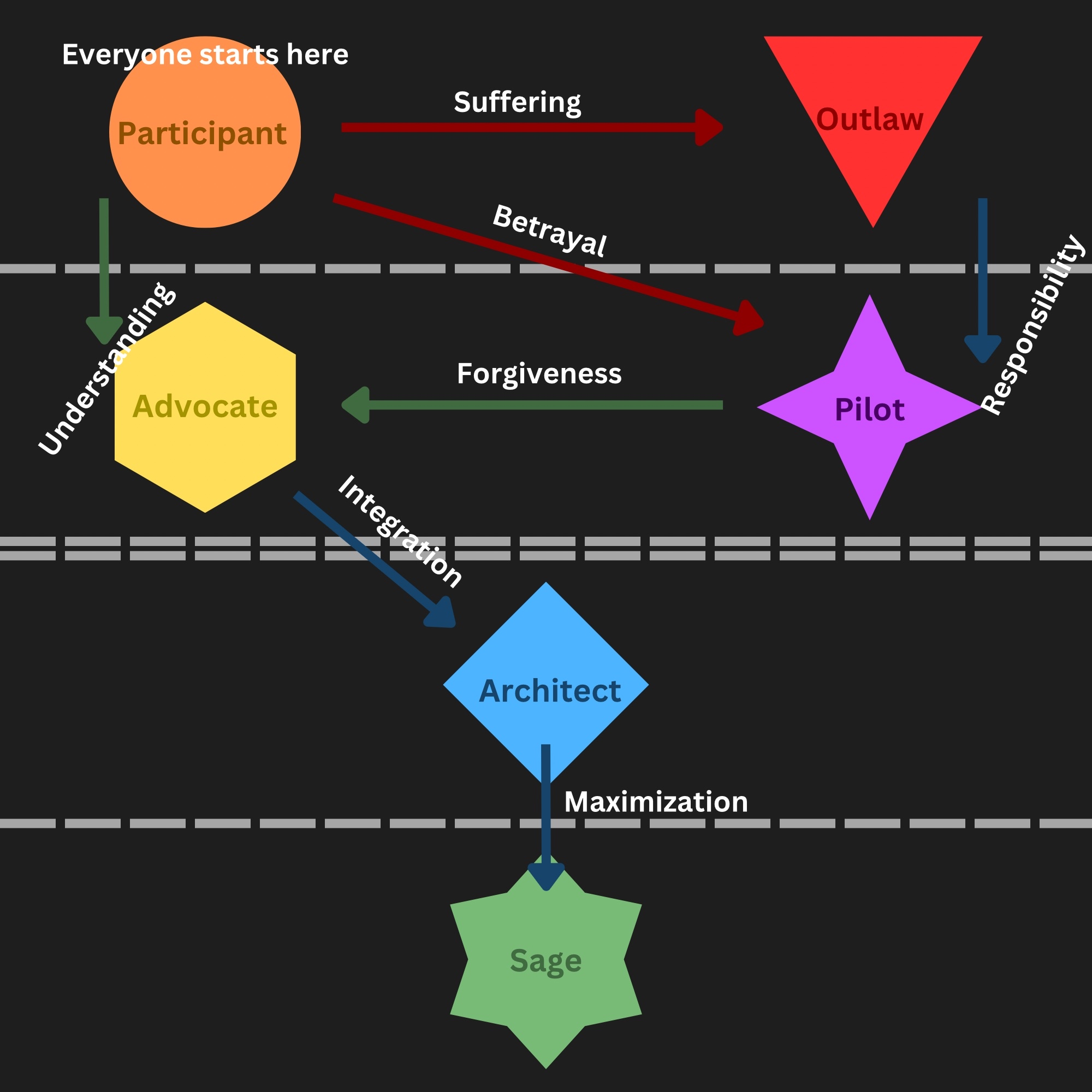
Most people begin life as a Participant, and many never truly leave this state at all. For the majority, it is the fixed point of the framework, the baseline of human cognition, the starting foundation from which everything else builds upon. If you’re curious on why this is: the vast majority of cultures I am aware of raise their children to play by the rules and accept the things told to them by their authority figures. Whether or not they actually do so is not the point, the idea is that most people start here because most are fed similar messages while they are an impressionable child. It also plays off the tribalistic nature of humans, which means we naturally collaborate with each other, so long as we’re in the same group.
That said, Participant is not the only possible starting point. Some individuals, particularly those raised in unstable, neglectful, or chaotic environments, never get the version of childhood that produces Participant trust in the first place. Without a system that ever felt safe enough to belong to, there is nothing stable to rebel against later. These individuals begin in Outlaw, not necessarily because they suffered their way out of Participant, but because the circumstances that would have built a Participant’s trust in systems never developed. This doesn’t change the shape of the framework since Outlaw is still Tier I, still passive, and still exits the same ways, it only means the rank people first start in depends on what they were handed as children.
There are of course further exceptions beyond this, but these two starting points are the most accurate generalizations I could make with my knowledge. Even so, if either is incorrect, nothing about the rest of the framework really changes. This is very important to keep in mind as you read about the framework because, as previously stated, you almost never occupy a single rank in the framework, but instead occupy several simultaneously. People are complex, and unfortunately it is impossible to accurately place them in neat and tidy boxes.
Beyond that, the Metacognitive Framework divides life into four tiers of cognition:
- Passive Living: where life is endured more than directed. Includes Participant and Outlaw.
- Active Living: where life is taken into one’s hands, though still through narrow or incomplete lenses. Includes Advocate and Pilot.
- Systematic Living: where multiple valid perspectives merge into structured synthesis. Includes Architect.
- Maximal Living: where life is lived as fully as possible, transcending ego and embracing wisdom. Includes Sage.
Growth between these tiers depends on certain experiences and necessary reconciliations. The framework shows three paths of transformation:
- Red (Pain-based): growth forced by suffering, betrayal, depletion, and surrender.
- Green (Virtue-based): growth through empathy, forgiveness, reckoning, and understanding.
- Blue (Wisdom-based): growth through knowledge, responsibility, integration, and maximization.
Note that the base of each transition doesn’t need to be exclusively what it claims to be. As an example, while growing in virtue is obviously virtuous, it usually also includes some degree of wisdom, or was learned through some degree of pain. The bases are just primary, not exclusive.
I will walk through these tiers step by step, exploring the ranks, transitions, and lessons of each. And before going further, let me be honest about what this framework is: a descriptive lens built from personal observation and reflection, not an empirically validated model. It draws loosely on existing developmental frameworks, Integral Theory’s stage concepts most directly, but it hasn’t been tested, measured, or peer reviewed, and it isn’t trying to be. Its value is in whether it helps you recognize patterns in yourself and others, not in whether it would survive a psychology review process. This is a theory built from one person’s experiences, that same person not really knowing how useful said theory even is, so take it with a few grains of salt.
Tier I: Passive Living
Passive living is where human cognition begins. At this stage, people are not yet fully responsible for themselves. They tend to react to life rather than direct it, letting external systems or circumstances shape their lives. Individuals are defined more by their relationship to external forces, whether cooperative or antagonistic, than by inner autonomy.
Participant
Participants believe that their method of living is the one true way. They accept anyone who agrees with them and push away those who don’t.
Almost everyone starts as a Participant. Participants are not necessarily stupid, they are just oriented toward selflessness without agency. Their lives are framed by the systems around them, like family, school, religion, culture, work, etc. They follow the rules, fit into established structures, and play the roles assigned to them. Their sense of value comes from being “good” members of the group, such as responsible children, loyal employees, supportive citizens, or dutiful friends. For the vast majority of people, this is the primary mode of cognition, and almost nobody grows entirely out of Participant, even if they grow into other ranks. Life will never be void of structures we must at least partially conform to and participate within.
At this stage, meaning is not internally generated, but borrowed from external circumstances like traditions, expectations, and tribes. Participants rarely ask about the systems they are in, instead focusing on playing their part within them. Their lives are guided by trust in authority and comfort in belonging. As previously mentioned, most of humanity remains here indefinitely, not because Participants lack potential, but because the rewards are tangible and stabilizing. Belonging offers safety, routine offers predictability, and playing one’s given role avoids the existential burden of self definition. The world is chaotic, but systems make it navigable, so long as one accepts the rules. Participants keep society running, forming its foundation. They are the majority, the scaffolding upon which every higher rank stands.
It should be noted that Participants largely believe in inherited worldviews, which is important to consider because not all Participants will be given the same worldviews. As a result, most Participants disagree with each other since they are trying to play their part within different perceived systems. This creates a strong “us versus them” mentality in the vast majority of Participants, which should sound familiar from either your personal experiences or understanding of the world. Most people are genuinely trying to do what they believe is right without first questioning if others agree with them.
Additionally, passivity has limits. While Participants contribute, they rarely create. Their agency is outsourced to institutions, parents, bosses, laws, and traditions. Their sense of “goodness” depends on recognition from others, and if that recognition is withdrawn, or if the system itself betrays them, their identity collapses. That fragility is the mark of Tier I cognition.
Growing from Participant happens in three distinct ways:
Through Suffering: Long term dissatisfaction with passivity can slowly rot the Participant’s trust in society. If they feel unappreciated, stagnant, or exploited, bitterness builds, and they begin to see the system as suffocating. In time, this resentment boils into rebellion, pulling them into the Outlaw rank. This is, unfortunately, the most common escape.
Through Betrayal: A sharp, unexpected trauma can break the illusion of security in an instant, such as a trusted authority failing them, a system they relied on collapsing, or a loved one abandoning them. The result is a radical disillusionment that fundamentally rewires how they see the world and they begin to demand autonomy. This leap sends them directly into the Pilot rank. Though rare, it is among the most dramatic transitions in the framework.
Through Understanding: Some Participants, especially those with nurturing upbringings or reflective temperaments, grow in empathy rather than bitterness. They see not only their role within the system, but also the struggles of others within it. Instead of rebelling, they seek to champion and uplift those around them. This path leads them into the Advocate rank.
Thus, the Participant stage is the greatest threshold. It is where human cognition begins as safe, social, and structured, but fragile. The Participant clings to rules and belonging unless life, through pain, betrayal, or understanding pushes them beyond it.
Outlaw
Outlaws want to control as much as possible. They have a me-first mentality in most circumstances, neglect individual responsibility, and believe they are the exception to the rules.
Outlaws are selfish and passive. They do not take responsibility for themselves, but instead turn outward, trying to control external circumstances and manipulate the environment to bend life to their will, and are often misunderstood as rebels or free spirits because of this. They appear to reject the rules, but their rejection is not grounded in wisdom, it is grounded in bitterness. They have discovered that simply “playing along” does not bring fulfillment, yet they are not ready to take responsibility for themselves. Instead, they lash outward, blaming, scheming, or demanding control over everything but themselves.
The Outlaw is not actively building a better life for themselves, only reacting against the one they feel has failed them. Outlaws may gain short term satisfaction from breaking rules, seizing power, or manipulating situations, but their way of life is ultimately less sustainable than the path they left it for. Their rebellion is still anchored in dependence and they still define themselves against the very structures they claim to reject. It’s a tragic rank to be in.
Unfortunately, Outlaws possess the greatest capability of any rank to harm society since their willingness to disregard consequences and other people’s boundaries is largely unchecked. However, that being said, Outlaws are just as capable of fighting fiercely for noble causes like protecting the vulnerable, resisting corrupt authority, or standing where safer people won’t. What separates an Outlaw doing this from an Advocate or Architect doing the same thing isn’t the cause, but the means. To an Outlaw, the fight itself, the assertion of will, the refusal to be controlled or told what to do, is the actual point. The cause can be completely genuine and completely just, but to the Outlaw, it’s personal, they want to prove something, dominate something, and be the exception. That’s why Outlaws can look heroic in one moment and destructive in the next because, to them, it was never about the cause, it was always about the strength of imposing themselves.
There are three ways out of Outlaw:
Through Surrender: Outlaws who fail enough times without ever turning that failure into Responsibility can instead get worn down by the fight itself. Having spent themselves trying to control external circumstances and finding only isolation or defeat, some retreat into the relief of being told what to do again. It isn’t necessarily growth, it’s a collapse into borrowed structure, trading their burdens for the comfort of belonging. Essentially, the Outlaw gives up, goes back to Participant acceptance, and accepts their reality.
Through Responsibility: Outlaws can take Responsibility of their own lives. They stop demanding control over what is outside themselves and instead begin to manage what is within. Through knowledge and responsibility, the Outlaw can finally step into the Pilot rank, where selfishness becomes active, and true agency begins. Unfortunately, the Outlaw must come to this realization on their own due to their reluctance to listen to feedback. They must fail enough to realize that their way of life is still inadequate, which often means a lot of failure.
Through Reckoning: Some Outlaws, in the midst of causing collateral damage, are eventually confronted with the cost of their own methods. Unlike Responsibility, which comes from turning inward and managing the self, Reckoning comes from turning outward and finally seeing people clearly. This is essentially a redemption arc, it pushes toward the Advocate’s selflessness, often with an intensity that borders on overcorrection, since the guilt of past harm becomes fuel for present service. This transition is uncommon and somewhat slow as the Outlaw unlearns their unhealthy tendencies, occurring about as often as a Participant reaches Pilot through Betrayal, but when it happens, it produces some of the most committed Advocates in the framework, precisely because they know firsthand what the alternative costs.
Tier II: Active Living
In the second tier, people take a more active role in their lives. They are no longer purely passive members of society, but instead seize individual responsibility, even though selfishness and selflessness still remain divided and each rank leans heavily toward one or the other.
Pilot
Pilots believe it’s all up to you, within reason. People are different and complex, and as long as you achieve personal success without breaking the rules in the process, then who are they to tell you how to live?
The Pilot represents selfishness turned active. Unlike Outlaws, Pilots (at least attempt to) take control of their own lives. They are determined, knowledgeable, and unafraid to prioritize themselves. Where the Outlaw seeks control over others and external conditions, the Pilot focuses inward, mastering their own choices, skills, and opportunities. This shift transforms their selfishness into direct agency rather than reactive struggle. If you’re curious, I consider Pilot my default rank and the rank I have spent most of my conscious life within.
Pilots are highly pragmatic thinkers. They approach life as an internal problem to be solved, constantly looking for ways to improve their position and secure their independence, which often makes them innovators, strivers, or lone wolves. Unlike Participants, who find security in rules, Pilots use rules strategically by cooperating when it benefits them, but refusing to be confined by others or by structure. They view society as a tool to utilize rather than a system they must belong to. They understand themselves as an exception to the rules. They are smart enough to see that they have a higher understanding than those around them (Tier I thinkers) but not yet wise enough to use their knowledge to make themselves happier, only more successful. They believe that one day, they will have full control of themselves, and will be able to use that control to further improve their position, whatever the cost.
Additionally, though they know they have more agency than most, and though they sense their limitations, they may refuse to admit them, largely because it hurts their agency and/or ego. This arrogance is a double edged sword, because on one hand, it fuels their ambition and gives them courage to take risks others would shy away from, but on the other, it can blind them to stronger forms of collaboration, leaving them isolated and blinded by their own vision. Still, their sheer determination makes them powerful navigators of life, being capable of building careers, forging independence, and escaping cycles that trap others in ways that appear almost easy for them. They’re not on their “sigma male grindset” or whatever the fuck that is, rather they personally build their own success without adhering to whatever other people tell them success should look like. As a result, you might not accurately identify a Pilot when meeting one, since they simultaneously don’t fit in to established structures while also being involved in those structures.
It’s worth noting that while Pilots will respect rules and structures, they are not necessarily moral. They will allow and justify loopholes, acknowledge “necessary” evils, make bold claims or moves without concern for consequence, and while they almost never cross the line, they do get very close to it. Essentially, they will do however much they can get away with if it benefits them. They are, after all, still selfish, just actively taking responsibility for themselves and their chocies in the process.
The only path forward from Pilot is through Forgiveness. Pilots must learn to forgive, not necessarily those who hurt them, but in general. Forgiveness here is less about compassion and more about perspective, recognizing that most people act from limited understanding, not malice. Without this, Pilots remain self absorbed and defensive, stuck in a cycle of relentless self prioritization because nothing else appears worth it, and so they stay unhappy while also being unwilling to change. With Forgiveness, however, they soften, broaden, and slowly begin to open themselves to the inner lives of others, which allows them to understand the Advocate rank, where selflessness becomes active.
Pilots can either make Forgiveness the priority and become Advocates or begin integrating Forgiveness into their selfishness, meaning a Pilot can go into Advocate or into Architect depending on how they engage with their next steps. This doesn’t really matter with Pilots specifically, since when Pilots relearn selflessness, they usually don’t sacrifice their self prioritization in the process since they know what works for them, thus quickly begin to Integrate anyway. But it should be noted that either is possible. On the other hand, an Advocate learning to prioritize themselves is comparably much more difficult than a Pilot learning to Forgive.
Advocate
Advocates want to include and support everyone except those who disagree. They view the world as better than it truly is and, although noble, can do more damage than good because of it.
The Advocate is selfless and active. They fight for others, empathize deeply, and take on the role of hero, leader, or protector. Unlike Participants, they do not merely follow the rules, but also champion others’ needs. Their identity is built around service, sacrifice, and empathy, often at the expense of themselves. However, if someone disagrees with helping others, Advocates can become quite cruel. If others are unwilling to believe in, participate in, or at least accept the Advocate’s idealism, they shut them out completely because the Advocate interprets them as immoral. It sounds paradoxical, but it is pretty cut and dry, there has to be a line somewhere between who they will help and who they won’t, and they draw that line on moral bases.
Advocates are driven by a moral compulsion to help. They cannot stand by when someone is suffering, and they often feel personally responsible for lifting others up. This gives them a deep sense of purpose, but it also comes with a heavy emotional cost since taking care of others in any respect is difficult. As a result, Advocates frequently live with a paradoxical mix of fulfillment and exhaustion through feeling meaningful in their service yet drained by the constant outpouring of energy, prioritization of others, and neglect of themselves.
Unlike Pilots, who see the world primarily through their own perspective, Advocates deliberately adopt the perspectives of others by listening, validating, and recognizing multiple viewpoints. But this gift can easily become problematic because too much validation risks undermining growth, not only their own, but also the growth of those they try to help. They may soothe when challenge is needed, excuse when accountability is required, or protect when letting someone fail would help them more. In a sense, they are too noble. Read The Fallacy of Equality in Social Positioning for more details. This makes the Advocate one of the most tragic ranks in the framework. In their relentless pursuit of supporting others, they may reinforce passivity in those still at Tier I, giving Participants reasons to remain dependent or giving Outlaws justification for their bitterness. Advocates may unintentionally become enablers, mistaking compassion and sympathy alone for growth.
The only way forward for the Advocate is through Integration. For one, they must begin taking care of themselves, but two, they also must develop the ability to take multiple perspectives and forge them into structured systems, requiring generalizations. Advocates must stop holding truths as independent fragments and instead learn to combine them into coherent frameworks to understand what exactly brought things to their current place and what they can do about that. It is not enough to empathize, they must also synergize and synthesize. Through integration, Advocates evolve into Architects, transcending the cycle of self sacrifice and instead building durable systems that empower everyone involved, including themselves.
It is also possible for Advocates to forgo Integration in favor of serving themselves because Advocates who give without eventually receiving something run dry. The empathy stops being sustainable as the primary mode of living, and self preservation asserts itself. Unlike Forgiveness, which opens outward, Depletion closes inward, and the Advocate learns, often bitterly, that they must first provide for themselves before they can meaningfully provide for anyone else. This is a rare and difficult path, because it feels like unlearning the morality they fought so hard to champion, but it does exist. Furthermore, it is theoretically possible to bounce between Advocate and Pilot as one tries to find their place in the world, but if this is the case, eventually, they learn to Integrate.
Tier III: Systematic Living
The third tier is fundamentally different and much more difficult to grow into, hence the double line between the tiers. Here, cognition is no longer about passivity or activity, but about designing around them. Individuals begin constructing systems that combine multiple valid perspectives together to create the best possible generalized solution. If you’re curious, the Codex the Metacognitive Framework are fundamentally rooted in this level.
Architect
At and past this level, things get a little difficult to explain, but I will try my best.
Architects want to put everything in its proper place. They love knowing the optimal way to do things. They are aware of the endless complexities of life and are determined to develop harmony through systemization, not enforcement, contrary to all previous ranks. In practice, this means Architects stop treating decisions as binary choices and instead start asking how every choice can be integrated. A Pilot facing a friend in crisis asks “how much of my time can I afford to sacrifice?” An Advocate asks “how much left do I have to give them?” An Architect asks a different question entirely: “how do I build a way of showing up for this friend that doesn’t cost me my own stability so I’m not choosing between the two next time?” The Architect isn’t more generous or more disciplined than the Pilot or Advocate, they’re just no longer willing to treat generosity and self preservation as inherently opposing forces that trade off against each other, and they’d rather spend their effort designing their lives to have both at the same time.
Where a Pilot optimizes their own schedule and an Advocate says yes to as many people as they can, an Architect builds a system, a rule for themselves, a boundary, or a routine that decides those requests in advance so they don’t have to relitigate self versus others every single time. Where a Pilot cuts corners they can justify and an Advocate excuses people who let them down, an Architect tries to build the incentive or the habit that makes corner cutting and disappointment less likely to happen in the first place. They’re less interested in winning any individual argument, forgiving an individual person, or maximizing an individual outcome, and more interested in figuring out why the argument, the pain, or the shortfall kept happening, and building something that prevents it from happening again. Fundamentally, Architects want to solve problems at their root, thus trend towards intellect and humility, and usually topics like engineering, history, and even psychology.
Every earlier rank picks a side, stays there, and justifies it, via self versus others, rules versus freedom, or control versus empathy. Architects stop picking sides and start acknowledging nuance, not always because they’ve found a clever compromise, but because they’ve stopped believing the binary was ever real to begin with and started looking for the structure that lets both sides reinforce each other instead of competing. Architects conserve their energy by designing structures, whether social, personal, intellectual, political, anything really, that do the supporting for them. They know that a well crafted and adaptable system can sustain growth more reliably than any one person’s heroic effort.
This is why Architects can seem frustratingly slow or unwilling to commit to any side. It’s not necessarily indecision, it’s that picking a side usually isn’t the actual goal because they want to understand the conflict and fix it, not fight for it. Given a choice between two decent options, they’ll often try to figure out what each option is protecting, what each side is actually afraid of losing, why each side is acting the way they are, and see if there’s a version that satisfies both. Sometimes there isn’t, and they pick a side like anyone else, but the reflex to look for the third option first, rather than accept the two they were handed, is what separates them from the ranks before them. Regardless of how many options there are, they consciously reflect, investigate, and try to compromise before jumping to conclusions.
Furthermore, this instinct doesn’t stop at situations they can actually influence. Show an Architect a broken system they have no power over, like a political process, an industry, or even fucking concepts of things and they’ll still start working on a better one, even knowing they’ll probably never get to implement it. Not because they think anyone’s waiting for their solution, even if they like to believe that, but because leaving a bad structure unexamined feels almost physically uncomfortable for them. Where a Pilot shrugs at a broken system and works around it, and an Advocate tries to help its victims one at a time, an Architect starts asking what would actually have to change for the whole thing to stop producing the same problem. This is often mistaken for naivety or arrogance, as if they genuinely think they can create a flawless utopia with simply enough thought, but that’s not really the point, and they know they don’t have all the answers. This is just what it looks like when someone who solves problems for a living encounters a problem they can’t help but think about. Even if they know the problem is extremely complex, probably can’t solve it, and that they will never even get a chance to influence it, they will still attempt to solve it if it catches their attention.
Though all Architects share the same fundamental orientation, the systems they build are reminiscent of where they came from. An Architect who spent significant time as a Pilot before integrating tends to design systems that preserve individual agency and reward capability, and is simultaneously wary of structures that flatten people into interchangeable parts. An Architect who spent significant time as an Advocate tends to design systems that protect the vulnerable by default, building in safeguards against exactly the kind of burnout or enabling they once experienced firsthand. Neither instinct is wrong, and a mature Architect eventually accounts for both, but the emphasis, what they think about first, what they verify last, and what kind of failure worries them most, often still reveals which tier they spent the most time in before they arrived here. As an example, if you’ve paid attention to what the Codex or Adaptivism specifically emphasizes, or personally know me, I’m sure it’s not too difficult to tell that I’ve spent and still do spend a lot of time in the Pilot rank.
The Architect’s strength is also a challenge because systems can become rigid. There is a temptation to overdesign, to seek order where chaos is inherent or necessary, or to prioritize the system over the people it was meant to serve. Architects must constantly balance the elegance of their systems with the messiness of lived reality. Unfortunately, happiness itself cannot be systematized, although an Architect might keep trying to find the solution despite knowing that. See Systems in Cognition and/or Can You Outsmart Happiness? in Cognition for more details.
The only way forward is through Maximization, but not in the sense of refining the system further. Architects eventually run into a wall no amount of better design can solve, and even their best, most integrated structure will always be missing something. Maximization means finally letting go, not because the system inevitably failed at something, but because a system, no matter how good, will always be one step removed from the moment it’s responding to. Architects must eventually ask, not “how do I build a better structure for this,” but “what would it mean to no longer strictly abide by it?” That question can only be answered through lived experience. This leap takes them into the Sage rank, where the experience of building, testing, and dismantling systems finally settle into instinct, and wisdom stops being something constructed and becomes something simply lived.
Tier IV: Maximal Living
The final tier is not about control, rebellion, empathy, or even structure. It is about living as much as possible, beyond attachment itself, sometimes beyond systems, and usually beyond language.
Sage
I want to reiterate: at this level, things get even more difficult to explain, but I will try my best.
Sages want to maximize and come to peace with as much of existence as they can while retaining their understanding from the previous ranks, primarily Architect. They see the world largely for the complexity that it is (not necessarily understanding said complexity) and hold lightly to essentially everything.
The difference between an Architect and a Sage is in how each responds to the same situation. Give both that friend in crisis from earlier examples. The Architect, even a skilled one, still asks what structure fits here, what problem do they need solved, what worked last time, what boundary or framework keeps this sustainable, etc. It’s fast and it’s effective, but it’s still a process, a system being consulted, even if the consultation takes half a second. Meanwhile, the Sage doesn’t consult anything. They’ve built and dismantled enough systems by this point that the underlying judgment has become instinct. This isn’t the Sage having a better system, it’s the Sage no longer needing to consult one at all. They see enough of reality that they realize the generalizations required to become an Architect are just approximations to reality, not reality itself, and they begin to understand how to live in spite of ever-imperfect structure. Unlike every previous rank, Sages care more about asking questions than they do providing answers.
This is what separates a Sage from simply being a better Architect. It’s not that Sages have discarded structure and Architects haven’t, both know when a system is useful and when one has outlived its purpose, but Architects still fundamentally experience life as a series of problems to be solved, elegantly, sustainably, but solved nonetheless. The Sage has stopped experiencing life that way. Life isn’t inherently a problem waiting on a structure to solve it, it’s just what’s happening.
This makes Sages harder to predict than Architects, not because they’re inherently inconsistent, but because they’re not applying a rule you could learn and anticipate. Two people in nearly identical situations might get genuinely different responses from the same Sage because the they’re responding to the actual person, not to the category the person falls into. An Architect, even a good one, is still somewhat trusting a general solution against a specific case. A Sage has stopped generalizing at all because they no longer need to. Of course, they still see life through their perspective and through what they’ve experienced, but they’re simultaneously extremely humble and extremely wise.
None of this makes Sages infallible or always right, it just means that their rightness, when it happens, doesn’t necessarily have a method behind it. They can’t always explain why they knew to push here and let go there, because the knowing didn’t come from a rule they could hand you, it came from having lived through enough rules to no longer need one in the moment. They experience life fully and respond to every situation as… “maximally” as they can. It’s really hard to describe without feeling the experience of it. See From Rules to Rhythm in Cognition for more details.
This is also why Sages are difficult to learn from directly. You can study an Architect’s system because it’s intentionally built to be as functional and legible as possible, but you can’t study a Sage’s judgment the same way, because there’s no legible framework underneath it to investigate, only the years that produced it. The most a Sage can offer someone is presence and attention to where that specific person actually is, not a transferable method for getting where they are.
Anything beyond this rank becomes too fuzzy to describe because wisdom transcends language itself. For all practical purposes, reaching Sage is the endpoint of metacognitive development. It represents fulfillment, happiness, and meaning at their deepest levels. It is not necessarily the end of the journey, but the state in which the journey itself becomes the destination.
Interactions
Individuals live, work, and clash with others across all tiers. Below is a simplified map of how each rank tends to engage with others. You should recognize having or seeing some of these (very broad) interactions at some point in your life.
| From Row to Column | Participant | Outlaw | Pilot | Advocate | Architect | Sage |
|---|---|---|---|---|---|---|
| Participant | Mutual comfort in shared systems. | Fears and condemns Outlaws as disruptive. | Admires Pilots but feels intimidated. | Trusts Advocates deeply, seeing them as protectors. | Struggles to understand Architects’ frameworks, but nonetheless participates within them. | Views Sages with awe, but unknowingly misunderstand their abstractness. |
| Outlaw | Sees Participants as naive sheep. | Rivalry for dominance. | Respects Pilots’ agency, but envies their discipline. | Distrusts Advocates as manipulative or patronizing. | Challenges Architects, often rejecting their systems, but not productively. | Shrugs at Sages, unable to grasp detachment. |
| Pilot | Gladly works with Participants but focuses on themselves. | Sees Outlaws as what they “could have been.” | Competitive but very, very respectful of other Pilots. | Skeptical of Advocates, accusing them of weakness. | Fascinated by Architects, though wary of losing agency. | Struggles to grasp the Sage’s freedom from attachment. |
| Advocate | Protects Participants, often at their own expense. | Tries to “redeem” Outlaws, often failing. | Encourages Pilots to care beyond themselves. | Collaborative but prone to burnout and enabling. | Both admires and resists Architects’ systematic practicality. | Reveres Sages as living ideals of compassion. |
| Architect | Designs systems that utilize and elevate Participants. | Attempts to restructure Outlaws but rarely succeeds. | Offers Pilots perspective, sometimes provoking resentment. | Grounds Advocates, encouraging them to take care of themselves. | Loves to engage with other Architects as peers in synthesis. | Recognizes Sages as the natural end of their path or attempt to systematically retain control. |
| Sage | Sees Participants with compassion, neither pity nor scorn. | Accepts Outlaws without judgment, but does not enable them. | Encourages Pilots to loosen but not release their grip on control. | Affirms Advocates’ compassion while nudging them towards integration. | Releases Architects from over-structuring, teaching when to let go. | Other Sages are simply companions in fullness of life. |
Transition and Stagnation
Growth within the Metacognitive Framework is never without consequence or without risk. Each transition demands something of the individual, whether that be a surrender, a sacrifice, or the letting go of a former certainty. At the same time, refusal to move forward, or clinging too tightly to a single mode of thought, risks stagnation or regression. Both factors define the shape of the snake, each step of growth leaves a husk behind, and each refusal to move leaves one trapped in a skin too small to contain them.
Transition
Every transition in this framework has a cost. To enter a new rank means leaving something behind, and the greater the leap, the greater the surrender.
Lateral Transitions
- Participant → Outlaw: The cost is security. To leave behind the comfort of playing along, one must abandon the illusion that belonging is guaranteed. What was once safe now feels suffocating.
- Outlaw → Participant: The cost is agency. Outlaws who fail enough times without ever turning that failure into something become worn down from the fight itself. Surrender trades their desire to control for the relief of being told what to do again, even at the cost of their (supposed) autonomy.
- Pilot → Advocate: The cost is ego. Pilots must admit that their pain does not define all of existence, and that others’ intentions, though flawed, are often genuine. To forgive is to release the shield of defensiveness.
- Advocate → Pilot: The cost is output. Advocates give until giving no longer sustains them, often without receiving anything in return. Depletion forces the recognition that self preservation has to come before service, not as selfishness, but as a precondition for having anything left to give at all.
Vertical Transitions
- Participant → Pilot: The cost is trust. Betrayal shatters the belief that the world is fair or that rules will protect you. This transition feels violent because it is, the world rips away its mask, and you must now fend for yourself.
- Participant → Advocate: The cost is naivety. To grow through empathy, you must surrender the simplicity of blind following and confront the complexity of multiple valid perspectives.
- Outlaw → Pilot: The cost is pride. Outlaws cling to control of the external world while Pilots take ownership of the internal. This requires humility by admitting that you, not exclusively the world, are the problem.
- Outlaw → Advocate: The cost is denial. Outlaws justify the damage they cause as necessary collateral or don’t care about it at all. To move forward, they must stop looking away from who actually got hurt. This is one of the most difficult transitions in the framework as the Outlaw comes to terms with what they’ve done.
- Pilot → Architect: The cost is sufficiency. Pilots believe their own judgment is sufficient, that the right answer is the one they’ve reasoned their way to alone. Integration requires admitting that other perspectives aren’t obstacles, but different kinds of solutions.
- Advocate → Architect: The cost is certainty. Advocates thrive on championing others, but integration forces them to admit that virtue alone does not suffice. To systematize is to dissolve the illusion of any absolutes, including moral ones.
- Architect → Sage: The cost is attachment. Architects must release their grip on not only systems and structures, recognizing that no framework can capture life in its entirety, but also the external world in general. Detachment allows the Sage to live fully without relying on control.
Growth is not necessarily additive. You do not simply gain new skills or insights, you also surrender pieces of yourself in order to become something else.
Stagnation
Just as there are costs to growth, there are consequences to refusing it. To linger too long in one rank is to risk corruption of its virtues into their lesser forms. Each rank contains a trap, a way in which its natural mode of cognition, if left unchecked, folds in on itself.
- Participant Stagnation: Comfort becomes conformity. Participants who never grow may lose individuality altogether, becoming little more than extensions of the systems around them. Insecurity makes them cling harder to rules, defining meaning by obedience.
- Outlaw Stagnation: Rebellion hardens into bitterness. Outlaws who never mature often default to narcissism or nihilism, resenting a world they cannot control yet simultaneously refusing to control themselves.
- Pilot Stagnation: Agency rots into tyranny. Pilots who cling to self prioritization can become dictators of their own lives, endlessly improving and conquering yet never forgiving or truly being happy. Their strength ultimately becomes a cage since their efforts never solve their misery.
- Advocate Stagnation: Empathy becomes indulgence. Advocates who cannot integrate perspectives often enable weakness in others, mistaking comfort for growth and sympathy for salvation. They martyr themselves to causes that no longer truly help anyone while telling themselves otherwise.
- Architect Stagnation: Structure calcifies into rigidity. Architects who fall in love with their frameworks risk suffocating within them, confusing complexity with truth and the map for the territory.
- Sage Stagnation: Even here, stagnation lurks. Detachment may turn into apathy. What was once freedom from attachment may collapse into refusal to engage with reality at all.
Regression is also possible, although not applied in the traditional sense since, in this framework, you occupy several ranks at once. A Pilot who cannot forgive may unconsciously slide back into Outlaw bitterness. An Advocate drained of energy may collapse back into Participant passivity. The snake does not move only forward, it coils, recoils, and sometimes retreats. Growth, then, is not a linear path, but a process of negotiations. Each transition asks for sacrifice and each delay risks decay. To live metacognitively is to accept that learning itself, though costly, imperfect, painful, and never complete, is the only true safeguard against stagnation.
Conclusion
Growth always demands something of you, whether to suffer, to take responsibility, to understand, to forgive, to integrate, to maximize, etc. The Metacognitive Framework is not about judgment, but about recognition, of seeing where you are, where you’ve been, and where you might go next. This framework should make some sense when applied internally, but be cautious when applying externally. You might clearly see your own path, but you can’t see exactly where others are coming from or exactly what they’re growing into, at least not in full, because of the nature of consciousness itself and because of the complexity of the framework and of each individual’s journey. Read Between Mirrors in the Relational Tensions section for more details. As an example, you might view somebody as a Pilot, while from their perspective, they are an Architect who just so happens to appear as a Pilot in personality and/or behavior. Or you see someone as a Participant when in reality they are a Sage. Or they appear as an Advocate but are actually a slightly outspoken Participant. And they might occasionally act in a manner that contradicts your illusion. Others can only be judged through their external manifestations while this framework emphasizes internal intention and understanding, thus, it is difficult to place others on this framework.
In a similar yet somewhat paradoxical vein, it is also difficult to place yourself on this framework. Without extensive understanding of how you function, what holds you back, and the journey your life has been on at large, it is extremely easy to bias yourself into any rank on the framework. It is paradoxical, because the framework demands absolute honesty, but if absolute honesty was present, the map would become somewhat unnecessary. So… this whole thing might be pointless. Yay! At least it’s fun to look into I guess.
In the end, cognition is primarily about three separate things: 1) thinking, 2) thinking about thinking, and 3) simply living. The further you move through the framework, the more life becomes not something endured or resisted, but something embraced, understood, and enjoyed, despite its difficulty.
Related Entries

The Fallacy of Equality
Nothing about your place in the world is fixed. Sustaining it takes continued growth from both yourself and the systems you depend on.

Can You Outsmart Happiness?
Happiness resists intellectual control. The mind can set the stage for contentment, but the experience itself flourishes only when we stop trying to engineer it.

Between Mirrors
We each carry two conflicting identities: the person we believe ourselves to be, and the person others perceive us to be. This unavoidable gap between internal and external perception shapes everything from our relationships to our personal growth.
Loading comments…