Knowledge
The acquisition of knowledge is the process by which a person sharpens their perception, extends their agency, and expands their influence over both internal and external conditions. Knowledge is not simply a collection of facts or concepts, but also a resource that transforms what one can do, anticipate, question, understand, and resist. The person with knowledge moves through the world differently because they (largely) see it for what it is, not what it appears to be. Thus, it is neither idealistic nor illogical to claim that knowledge is power, because it is power in the most literal, mechanical sense: it enhances the capacity to shape outcomes. Those who acquire knowledge with intention secure for themselves advantages unavailable to those content with inherited assumptions or superficial awareness.
Acquisition
Knowledge begins with exposure, but is truly learned through filtration. Most people confuse information with knowledge, failing to distinguish between raw data and actionable understanding. Information is everywhere: in conversations, books, environments, behavior, etc. But until it is contextualized, interrogated, and connected to what is already known, it remains powerless. Acquisition, at the highest systematic level, properly executed, involves four steps:
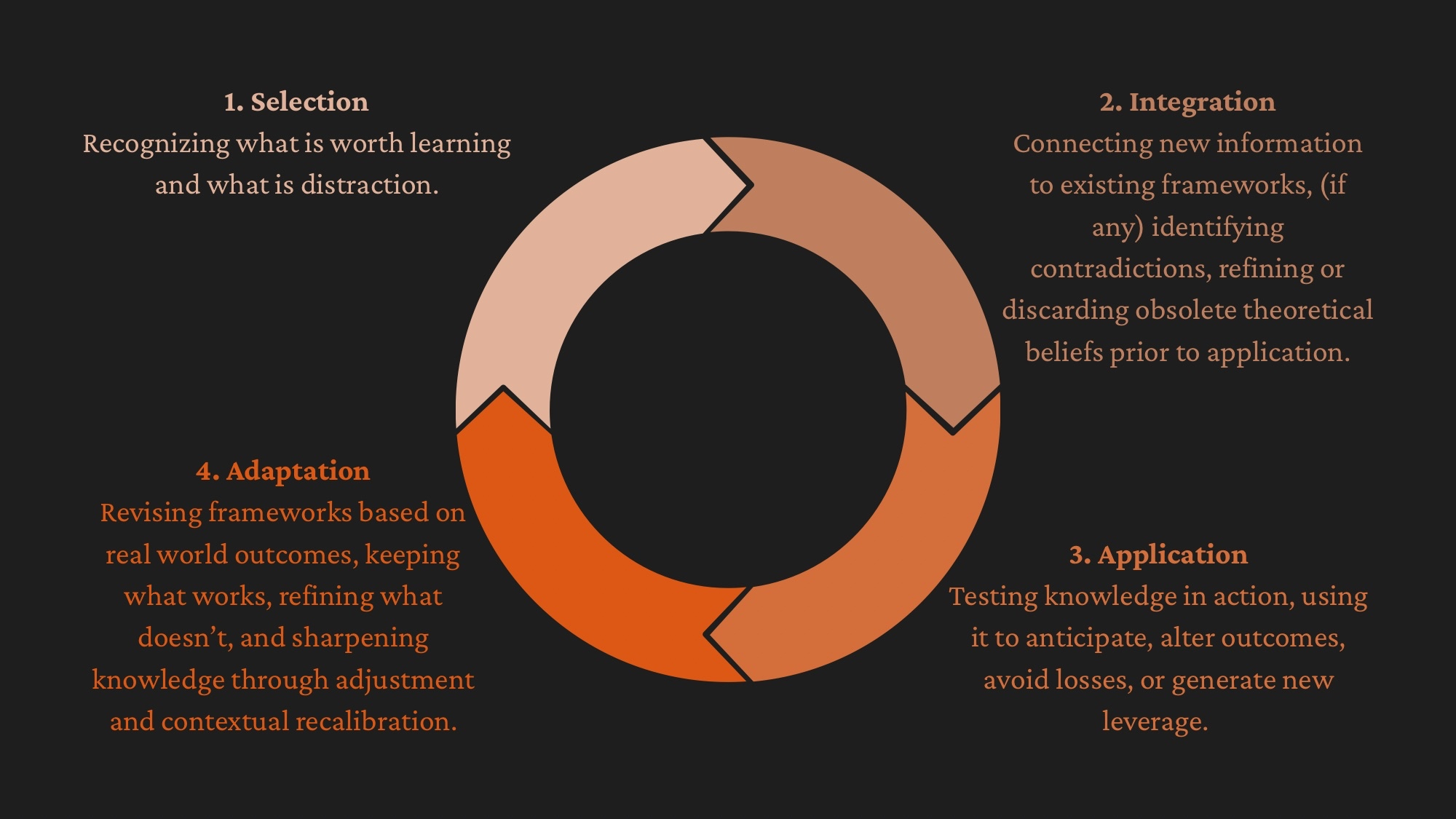
This process is recursive and no steps can be skipped. It requires both theoretical understanding and practical application. Every new piece of knowledge modifies the filter through which future information is judged. The more you know, the sharper your selection process becomes. The novice absorbs as much as they can, while the veteran discards ninety percent of what crosses their path, honing in on what disrupts, confirms, or strategically enhances their understanding. The acquisition of knowledge is a permanent and repeating process of a competent life.
Abilities
The more knowledge you gain in any area, the stronger the following abilities become.
The first and most immediate ability knowledge creates is pattern recognition, the capacity to notice recurring structures, causal relationships, and embedded incentives within complex systems. The ignorant see events as isolated incidents while the informed see them as inevitable results of conditions and choices. A historian does not merely know facts about past events, they see history repeating itself in patterns within present behavior. A strategist does not merely understand human nature, they map its strengths and weaknesses and use them to predict or shape outcomes. A person who studies their own emotional tendencies recognizes when their instincts are about to lead them off course. Pattern recognition converts a chaotic, overwhelming world into a network of interconnected probabilities and tendencies. It grants a person the ability to predict, not with certainty, but with increasing accuracy, which in practical terms is all that really matters.
The second ability is option expansion, the widening of available responses in any given scenario. Knowledge prevents a person from being trapped in binary thinking, false dilemmas, and reactive stances by revealing alternative routes where others see dead ends. A tactician who understands the process of negotiation possesses more than the standard options of aggression or submission, they also perceive delay, redirection, misdirection, and incentive structuring. A person who studies markets recognizes when the masses are driven by emotion and when opportunity exists by exploiting it. A self aware individual sees the choice not only between indulgence and abstinence, but also between strategic indulgence, temporary abstaining, and redirection of desire. In any situation, knowledge increases the number of viable moves, and in an uncertain world, one who has more options available survives longer, suffers fewer losses, and exploits more openings.
Another ability is foresight, anticipatory defense, or the capacity to identify emerging threats before they materialize. This requires understanding how systems fail, people deceive, and incentives warp outcomes over time. The person ignorant of these patterns is reactive, constantly surprised by betrayals, market downturns, personal crises, or ideological shifts. The person with knowledge observes the precursors and makes adjustments long before others notice. They see the cracks in alliances, the overextension of resources, and the misalignment of incentives. This ability is predictively vigilant, it allows for controlled risk taking, for placing oneself where probabilities favor them in the long term. In both social and practical terms, it reduces the incidence of losses, from minor to catastrophic.
The fourth ability is selectivity because knowledge refines judgment. The uninformed evaluate options based on impulse, appearance, or sentiment while the informed evaluate based on structure, precedent, and consequence. This difference determines who wastes years on doomed pursuits, who invests resources into unwinnable conflicts, and who repeatedly mistakes temporary excitement for solid opportunity. Knowledge enables a person to distinguish between the spectrum of signal to noise, between essential risks and meaningless hazards, and everything in between. A discerning person wastes less time, energy, and social standing by placing their bets where outcomes matter and probabilities favor them. They do not chase every opportunity, but pursue selectively, and that selectivity is what makes them effective.
Finally, knowledge grants disciplined adaptation, the ability to adjust beliefs, strategies, and behaviors as new information reveals itself. Most people cling to outdated knowledge because it grants psychological comfort, but the intelligent discard it because it impairs function. This requires not only awareness of new information, but also recognition of when previous perspectives no longer serve their purpose. The ability to pivot without loss of identity or collapse into nihilism or blind conformity separates those who merely accumulate knowledge from those who use it effectively. Adaptation does not mean abandoning principles, it just means updating tactics, recognizing when conditions shift, and avoiding the fatal rigidity that has toppled every empire, institution, and ideology that mistook temporary success for eternal victory.
Hierarchy
Not all knowledge is equally valuable. Practicality matters, especially so in this context. Theoretical knowledge has its place, but practical application must exist alongside it. Reality is complex, everchanging, contextual, and rarely aligns cleanly with theory, especially prior to its application. Without real world engagement, there is no way to accurately predict how any theory will actually perform. Application determines practicality by forcing confrontation with unexpected consequences and the interconnectedness of unforeseen factors. Of course, this means context matters a lot when practicing application, but that’s a given with theory as well.
A competent person seeks first what is necessary, then what is advantageous, then what is vanity. The knowledge hierarchy is as follows:
- Survival knowledge: What keeps you alive, out of avoidable danger, and functionally independent.
- Strategic knowledge: What increases your ability to navigate institutions, systems, people, and the world you are in at large.
- Self knowledge: What helps you keep yourself in check and consistently growing, what matters to you, and what helps you thrive.
- Supplementary knowledge: What refines your craft, deepens your analytical capability, and expands your abilities.
Notice that while the forms of knowledge discussed in this entry span multiple tiers, what most people imagine when they think of knowledge typically belongs to the “Supplementary” tier, the least important in the hierarchy. This is because we tend to glorify specialized or abstract knowledge while neglecting the foundational abilities required to utilize it effectively. It doesn’t matter how complex or well designed your ship is if you don’t know how to navigate with it. You need a solid foundation in staying alive healthily enough, operating in the modern world, and understanding yourself at least well enough to make proper use of any other form of knowledge. This is why the Codex discusses strategic and self knowledge excessively. A person with a small, simple ship they understand deeply is still going somewhere. A person surrounded by a bunch of complex knobs and dials they don’t understand is going to sink eventually.
Eternal Scholar
No matter how much is learned, complete mastery is never truly reached. The acquisition of knowledge reveals not only new abilities, but also emerging ignorance and complexity. Every system, skill, theory, or anything, when understood deeply, exposes its own limitations, exceptions, and contradictions. This is an inherent feature of a complex reality.
Furthermore, the illusion of having “arrived” is one of the most dangerous myths an intelligent person can adopt. Those who believe they have nothing left to learn stagnate, become rigid, and gradually develop a disconnect from reality. Even foundational knowledge can degrade as conditions shift. Because, one way or another, ideas evolve, contexts differ, the world changes, and what was once sufficient understanding must be revisited, not because it was wrong, but because the world is not static. See The Myth of Arrival in Developmental Realities for more details. Thus, the competent person remains a permanent student, an active interrogator of patterns, assumptions, and emerging variables. They recognize that the more they know, the more precise their awareness of what remains unknown becomes. The ability to recognize one’s ignorance is a humility that prevents complacency, sharpens observation, and maintains the intellectual flexibility required to pivot when yesterday’s certainties collapse. Ultimately, the pursuit of knowledge is a mountain without a summit. You learn to climb not to reach a final destination, but because the alternative is always either stagnation or regression.
The acquisition of knowledge is not a virtue in itself. It is a tool, a multiplier of power, and a mechanism for agency. Its worth is measured not in how much one knows, but in how effectively that knowledge translates into superior perception, decision making, and control. The person who understands without applying builds a library in a collapsing building. The person who applies without understanding creates a tool they don’t know how to use. In a world governed by complexity, scarcity, and conflict, knowledge is functional power, it’s an ability that multiplies agency, expands options, and anticipates what others miss. True competence demands not just knowing and doing, but acquiring and wielding knowledge with precision and intent, constantly refining what one thinks they know.
Related Entries

From Rules to Rhythm
The more you understand about anything, the more it becomes an art and less of a science.

The Myth of Arrival
We are often misled by the myth that we can arrive at a final, perfect version of ourselves. But true growth is an ongoing, unfinished process.

Theory Versus Application
Libraries and tools function differently and require each other.
Loading comments…