About

The Codex is a personal philosophical project built on a single uncomfortable premise: most advice is not designed to be true. It is designed to be easy, to make you feel better, or to give you something to believe in. That being said, the Codex will not always be true either, but it will not intentionally lie to you just to preserve comfort.
This is a collection of uncomfortable questions, ideas that resist simplification, and tensions you will learn to navigate rather than solve. The world does not care about your need for coherence, and coherence will never last due to the fundamental reality of change. So rather than proposing simple answers, the Codex focuses on clarifying the questions themselves. That might sound futile to some, but it is the literal definition of philosophy.
The Codex is built on the original philosophy of Adaptivism. See details below.
Adaptivism

Life is not a fixed equation but a dynamic interplay of contradictions and conflicting desires, requiring continuous adaptation, deliberate choice, and the integration of opposing forces to create meaning, purpose, and fulfillment without rigid absolutes.
The Five Pillars
1. Contradiction as a Fundamental Reality. Life's tensions: freedom vs. belonging, control vs. vulnerability, among others, aren't problems to solve. Truth lives in the friction between opposites. You don't choose sides, you learn to integrate within paradox. Strength and vulnerability, ambition and rest: the art is holding both without breaking.
2. The Fluidity of Meaning. Meaning is not discovered but created and revised through engagement with the world. It exists in the tension between belonging and purpose. Faith in any form must remain flexible to avoid rigidity.
3. Pragmatic Objectivity. Perfect objectivity is impossible, perfect subjectivity is impractical, but structured subjectivity, grounded in reason, expertise, and shared principles, is necessary for societal function. Truth is not absolute, but some truths are more useful than others. Truth is not relative, but some truths are more up to interpretation than others.
4. Agency Amid Uncertainty. Radical ownership of your choices is essential, but hyper-agency (denying external forces) is delusional. The self is not a fixed entity but a constant work in progress. You are responsible for your response, even when you are not responsible for your circumstances.
5. Adaptive Resilience. Rigidity leads to stagnation. True resilience is not armor, but the courage to stay flexible, fall, recalibrate, and move forward. Flexibility over certainty: principles guide, but absolutes imprison.
Organization
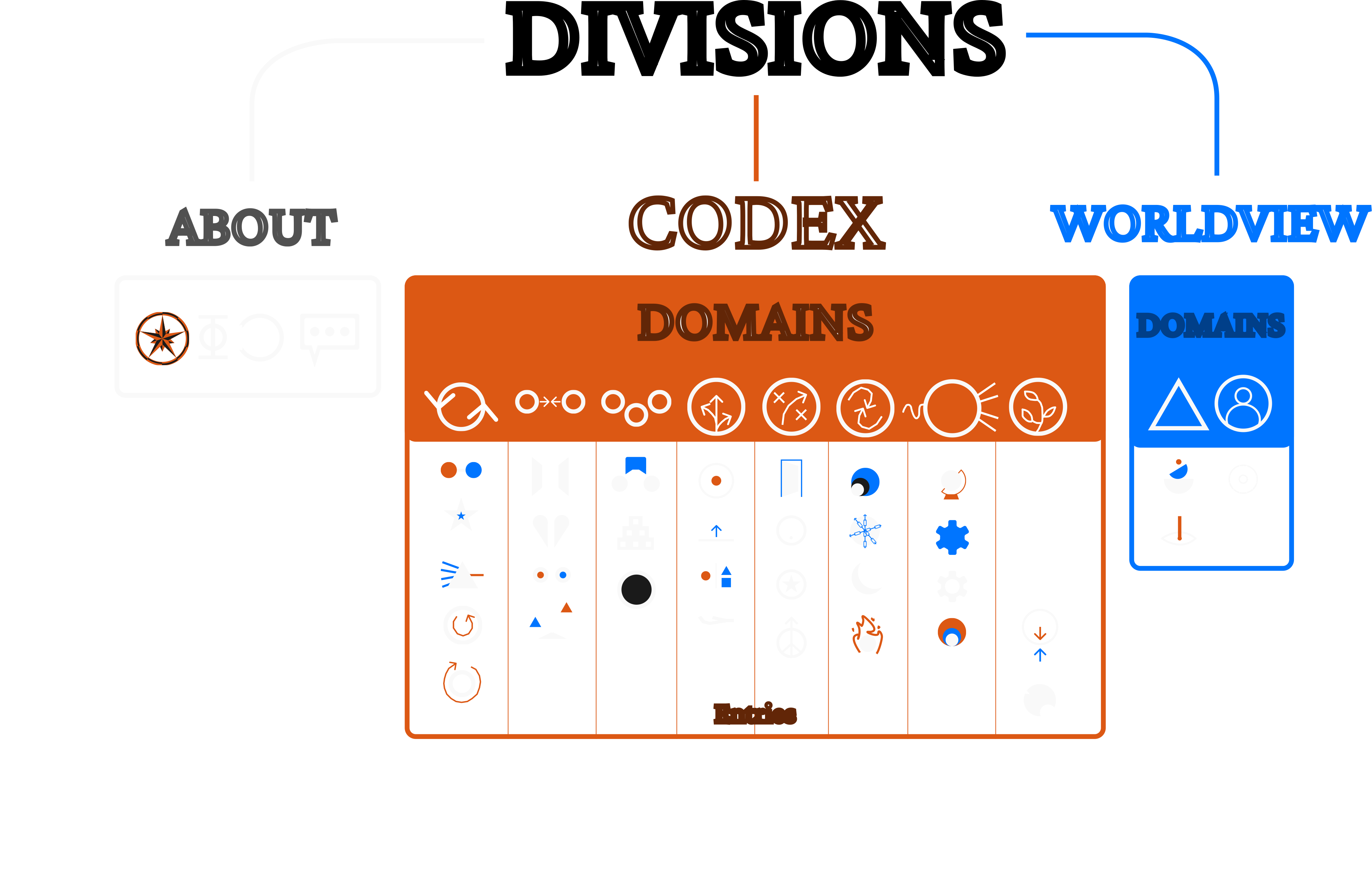
The Codex is divided into Divisions, each with Domains, serving as distinct contexts in which the philosophy plays out. The Adaptivism domain contains five entries going into depth on each pillar above. Every other domain is an application of that theory under a different lens: relationships, cognition, identity, growth, and so on.
The diagram below shows the full structure.
Reading
The Codex is designed so you can jump to whatever entry interests you. But its structure also forms a larger narrative. You can read it in any order you like, or follow the given sequence. Either way is acceptable, either way is by design, and either way you will notice lots of parallels between entries.
If you have no idea where to begin, start with Adaptivism. Then choose your own path.
Authorship
The Codex has been written and developed exclusviely by myself, Kyle King. I have synthesized wisdom from philosophical knowledge, psychological knowledge, physiological knowledge, personal experience, peer discussion, and the general trajectory of my life as a whole. I'm not claiming to know all the answers, but I have been writing extensive philosophical accounts for years. The Codex is simply the most organized and professional of those attempts.
If you would like to learn more about the Codex, I suggest looking further into the Context division and the Worldview division. If that is not sufficient, I am considering setting up some sort of communication with myself if you would like to converse with me directly.